AI-Powered UX Research: Run Research at the Speed Your Team Actually Needs
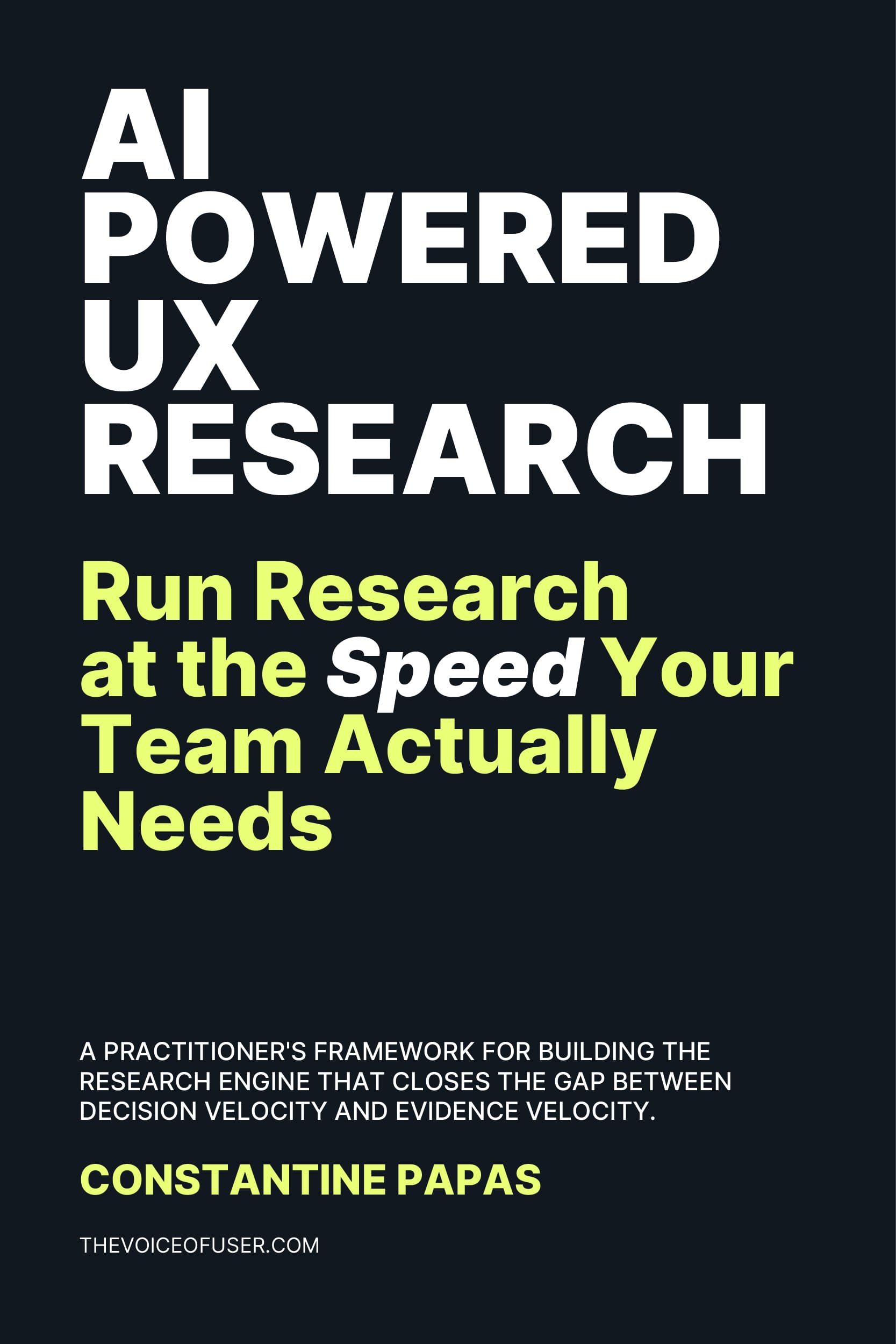
The book AI-Powered UX Research: Run Research at the Speed Your Team Actually Needs is out! The Kindle edition ($9.99) and the Paperback ($23.99) are both live on Amazon now, and the paperback has expanded beyond Amazon to Barnes & Noble, Books-A-Million, IndieBound, Walmart, and a growing list of other retailers. There is now a premium hardback edition, and the audiobook, narrated by Wes Malik, is out on Audible.
It is also in Kindle Unlimited, so if you already have a subscription it costs you nothing extra.
It hit #1 in User Experience & Usability on Kindle in its first week, which I did not expect!
The Problem I Kept Seeing
Every organization I have worked in or talked to has the same dysfunction. The research function is staffed with capable people running well-designed studies and producing technically sound findings. And the findings keep not mattering. Not because nobody reads them. Because by the time they arrive, the decision has already been made, the roadmap has already moved on, and the readout is now a Confluence page that will be visited three times total, two of which will be the researcher checking whether anyone visited it.
I spent years assuming this was a communication problem. Better readouts. Better stakeholder relationships. Better timing.
It is not a communication problem. It is a structural problem. The research operating model was built for a world where building was slow enough that a study could intercept a decision before it was made. That world is gone. AI has compressed the product build cycle to the point where the old model cannot keep up. Research has not kept up either. Not because researchers are not good. Because the function has not been redesigned for the tempo it is now operating in.
What the Book Introduces
The book is built around three things.
The first is a taxonomy of research modes. Not all research questions are the same and treating them as if they are is where most research dysfunction starts. Some questions need an answer in 24 hours. Some need two weeks. Some need months of foundational work that cannot be compressed without losing the thing that makes it valuable. The book introduces three modes, micro research, sprint research, and deep research, and a routing logic for deciding which mode a question belongs in based on risk, ambiguity, and how quickly the answer expires. Two of those modes are made possible by AI-moderated data collection with real participants, which is new enough that most functions have not yet worked out what it changes about what research can contribute.
The second is the Frame. The Frame is the organization's accumulated, actively maintained model of its users. Not what it has studied. What it currently believes, how confident it is in each belief, and where the gaps are. The book makes the case that fast research is only useful if there is something to plug into, and that without the Frame, micro and sprint research produce precise answers to the wrong questions. It covers how to build the Frame, how to maintain it, how to make it findable where decisions happen, and what happens when it degrades, which it always does, usually invisibly, usually until something ships and fails in a way that current research would have predicted.
The third is governance. Not the conference-talk version of governance where everyone agrees research should be strategic and nothing changes. The operational version. How to route incoming requests. How to protect deep research from the gravitational pull of fast work. How to maintain quality standards when multiple people are running studies simultaneously. How to scale research output without scaling headcount. And how to make the transition from a service model, a function that responds to requests, to an intelligence function, a function that maintains organizational knowledge and shapes decisions upstream.
Why I Think It Matters
I have been writing about these ideas on this site for a while now. The readout piece. The Frame piece. The dev orgs piece. Etc. Each one was an attempt to name something I kept seeing that nobody else seemed to be naming directly.
The book is where those arguments connect into a system. Not a collection of takes. An operating model with enough specificity that a researcher can close the book and know what to do on Monday morning.
I ran alpha reads with research leaders across the industry. The conversations were good. Some teams are already implementing elements of the framework. That was not what I expected when I started writing and it is the thing that made me feel like the book was worth finishing.
How to Get It
The Kindle is $9.99 and the Paperback is $23.99, both on Amazon. It is also in Kindle Unlimited, which means it is included if you already subscribe. The paperback is now also available at Barnes & Noble, Books-A-Million, IndieBound, Walmart, and a growing list of other retailers, for anyone who would rather not buy from Amazon. If you want a premium copy, there is a hardback edition. And if you would rather listen than read, the audiobook is narrated by Wes Malik and available on Audible.
And if you read it and it is useful to you, an honest review would mean more than I can say.
If you are a research leader who wants to talk through any of this, my email is on the about page.