Is UXR going extinct?

I wasn't planning to post this week. I'm dealing with some family health issues, and I wanted to take a short break from writing. Then Lenny Rachitsky published his latest job market report. A post about it started going around among UX researchers, and many of the comments asked whether our field is going extinct. I couldn't leave it alone.
For UX research (UXR), Lenny used data from Live Data Technologies, which tracks job changes for 124 million professionals. About 1,800 user researchers were hired in the US over the past year, down 66% from 5,300 in 2022. That was the steepest drop of any role he looked at, and hiring fell another 22% from the year before.
He also used data from TrueUp, which tracks openings at more than 9,000 tech companies. It showed only 108 open UX research jobs at tech companies worldwide. In 2025, Meta and Google alone made about one in eight of all US user research hires. Lenny ended the section with this: "I wonder if UXR as a dedicated function is going extinct."
I don't dispute the numbers. They match what I found when I looked at how bad the UXR hiring market is in August. Behind each of them are people, and many of those people are reading the same thread.
But "extinct" is the wrong reading, because it misses three things. The 2022 starting point was the top of a bubble. The counts measure a job title at tech companies, and much of the work now happens under other titles. And demand for research is going up while dedicated research seats go down. I've called this the K-shaped divide, where one part of a field grows while another part shrinks.
The 66% drop is measured from the top of a hiring bubble
The headline numbers in Lenny's UX research paragraph are compared with 2022. In 2022, tech hiring was at the peak of a boom, and his own numbers show it.
US companies hired about 239,000 software engineers in 2022, and about 113,000 over the past year. They hired 27,600 product designers in 2022, and 12,600 over the past year. Engineering hiring fell by 53%, design by 54%, and user research by 66%. Each of the three roles lost half or more of its 2022 hiring.
UUser research fell furthest because it had risen furthest. In August 2023, Kathryn Brookshier at Indeed published job posting data indexed to the first quarter of 2018. On that scale, UX research postings peaked at 566 in early 2022, which is more than five and a half times their 2018 level. Software engineering peaked at 404, product management at 381, and UX design at 265.
By the second quarter of 2023, UX research had dropped to 153. Software engineering was at 124, product management at 115, and UX design at 77.
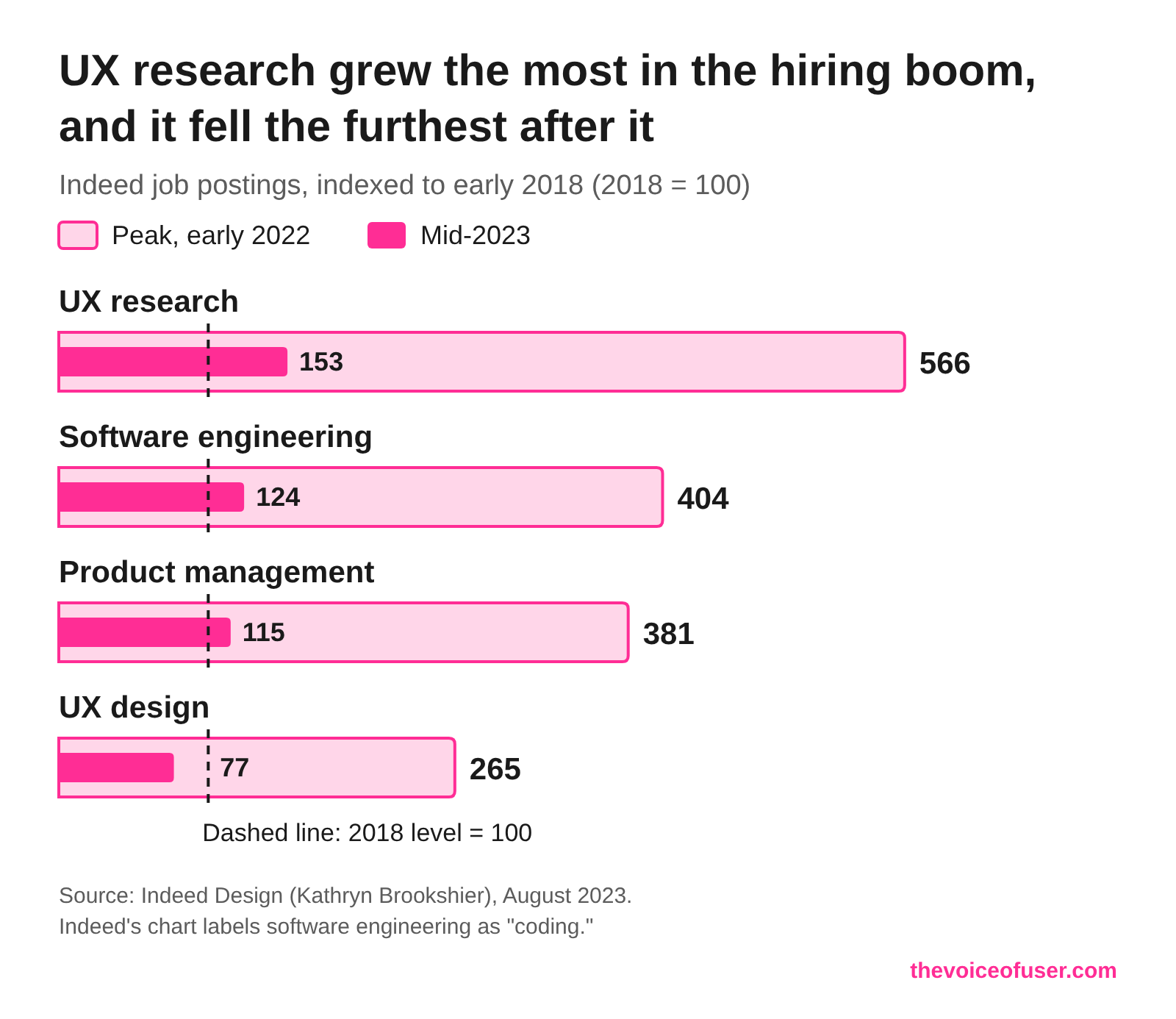
The 2022 peak was more than five times the 2018 level, so a large part of the 66% drop is the boom ending. Brookshier's later analysis of Indeed data, which runs through the end of 2025, found UX research postings roughly flat since the second half of 2023. She also found that they held up better against their 2018 level than design or engineering postings, which both dipped below it.
User Interviews, a research recruiting platform, found something similar. In its 2025 State of User Research report, 14% of respondents worked at organizations with no dedicated researchers. That was up from 6% in 2022, and down from 19% in 2019. By that measure, the field is somewhere between where it was before the boom and the top of the boom.
The TrueUp chart in Lenny's post makes the same comparison. It starts in August 2022, close to 800 open roles, which is where its "down 86% since 2022" is measured from.
The same chart also shows something the bubble doesn't explain. After moving between roughly 170 and 290 open roles through 2023 and 2024, it kept falling through 2025 and 2026, down to 108. The bubble explains the drop through 2023. It doesn't explain the second decline.
108 is the number of open UXR roles at tech companies on one day, not the size of the field
TrueUp counts open roles at tech companies at a single point in time. That's a useful measure, and it is a narrow one.
In June and July 2026, Brian Utesch, a UX researcher, collected 1,593 UX research job postings and analyzed them. His method is different, because he collected every posting over two months and TrueUp counts open roles at tech companies on one day. So the two numbers can't be compared directly. Still, the UX research job market is clearly larger than the 108 open roles in Lenny's chart.
Both counts also measure a job title, and research is increasingly done under other titles. In User Interviews' 2025 survey, 63% of respondents who no longer held a research title said they once did. People are leaving the title. Many of them are still doing the work, which is why they were answering a survey about research.
Lenny's own explanation describes research moving to other people, not disappearing
Lenny offered a theory for the drop. Product development is faster, so there is less time for traditional research. Teams are releasing earlier and learning after launch. And better tools, like Listen Labs and Simile, let people who aren't researchers do research themselves.
I agree with most of that. But learning after launch is still research. It runs on experiments and product analytics instead of interviews. In a 2009 paper on experimentation at Microsoft, Ronny Kohavi, who led the company's experimentation platform, reported that only about one third of the ideas Microsoft tested improved the metric they were designed to improve. Teams that learn after launch are still running studies. They just don't call them studies.
The money going into research tools shows the same shift. Listen Labs raised $69 million in January 2026 for its AI interviewer, and says it has run more than one million interviews. In September, Salesforce agreed to buy it, and the deal closed on November 2. Salesforce didn't disclose the price, but many outlets reported it at about $2 billion.
Simile raised $200 million at a $2 billion valuation in July 2026 to sell AI stand-ins for consumers that companies can survey instead of people. According to The Next Web, Simile built those stand-ins from two-hour interviews with 1,000 participants. Its accuracy figures of 85% to 99% are its own claims. So the company built to replace talking to people started by talking to a thousand of them for two hours each.
Companies and investors are putting billions of dollars into research tools, while hiring for researchers keeps falling.
Two other findings in Lenny's report fit this. Forward deployed engineers (FDEs) are the fastest-growing engineering specialty in his report, with openings up 4.6 times in a year. They are engineers sent into customer organizations to understand how people work and then change it.
In May, the researcher Stef Hutka proposed a forward deployed UX researcher, or FD-UXR. She wrote: "The core goal of both the FDE and FD-UXR job is: understand users, then change the way they work." So the fastest-growing engineering specialty in Lenny's report includes field research.
He also found "evals" among the ten most mentioned skills in product manager (PM) job descriptions. An eval is a structured test of whether an AI product's output is good for the people using it, and designing one well is research. Notion advertised a role in June 2026 called User Researcher, AI Evaluations, paying $196,000 to $230,000. Its job was to turn studies of user expectations into scoring rubrics for Notion's AI features.
Demand for research is rising while demand for dedicated researchers falls
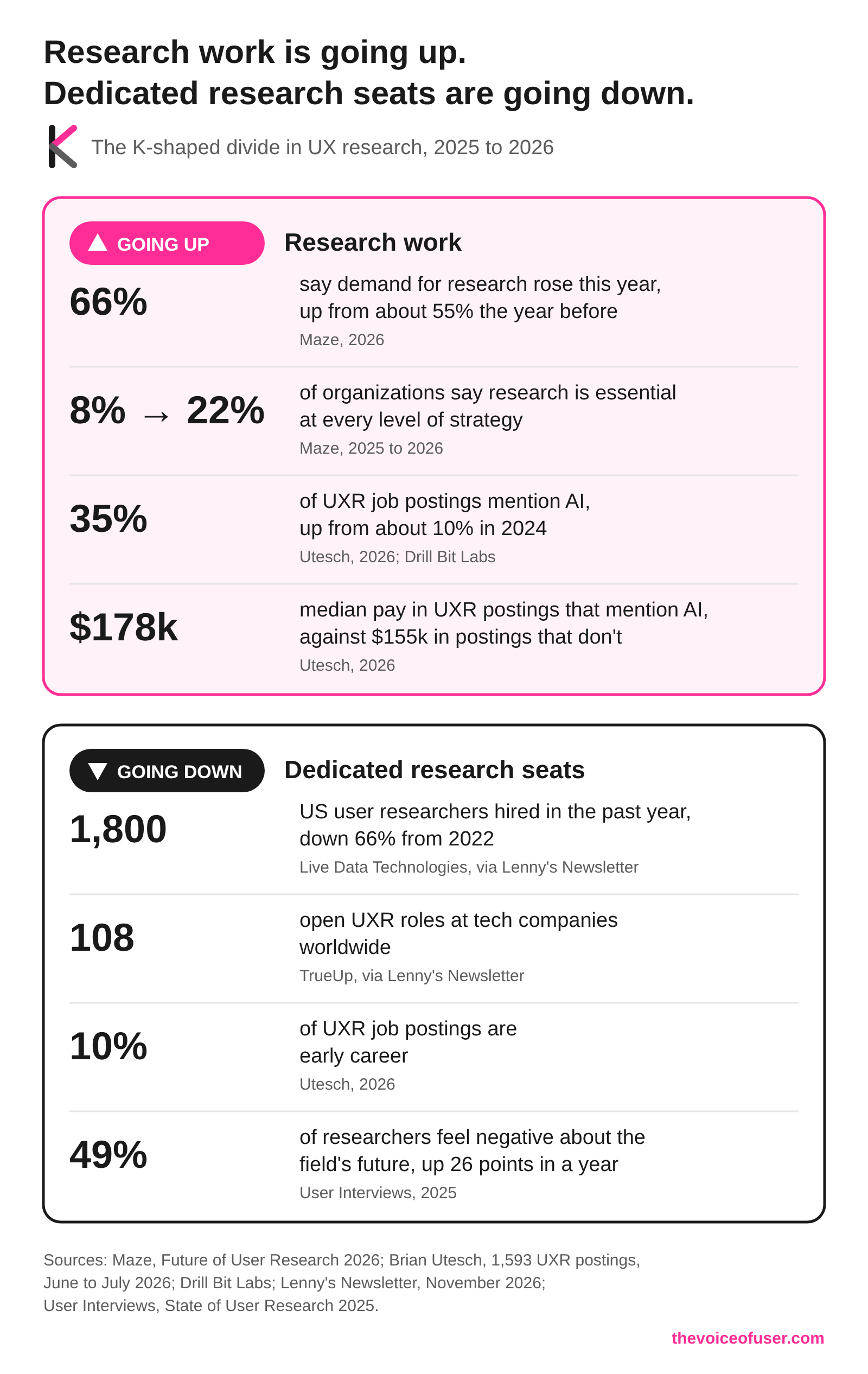
This is the K-shaped divide. Picture the letter K. From the same point, one arm goes up and the other goes down. In UX research, the work of producing and judging evidence about users is on the upper arm. The dedicated seats built around running studies as a service are on the lower arm.
Evidence for the upper arm is easy to find. Maze, which makes research software, surveyed nearly 500 researchers, designers, and product people for its 2026 Future of User Research report. It found that 66% said demand for research increased this year, up from about 55% the year before. The share who said research is essential at every level of strategy and operations rose from 8% to 22%. And 39% said product managers are conducting user research.
Utesch's postings show where the growing jobs are. In 2026, 35% of UX research postings mentioned AI, up from about 10% in 2024 in an earlier sample by Drill Bit Labs. Postings that mention AI had a median posted salary of $178,000, against $155,000 for postings that don't.
The postings are also senior. About two thirds were for senior, management, or executive roles, and 10% were early career. That matches the State of UX 2026 report from Nielsen Norman Group, a UX research and consulting firm, which found senior and generalist roles recovering faster than entry-level ones.
The lower arm is Lenny's report: 1,800 hires, 108 open roles, and a 22% drop in one year. It is also how researchers feel. In User Interviews' 2025 survey, 49% felt negative about the future of UX research, up 26 points from 2024.
Lenny's newsletter has published a split like this before. In July, Noam Segal and Lenny's annual survey of tech workers found that "the workforce is bifurcating into two realities," with people who feel amplified by AI thriving and people who feel diminished by it struggling. That is a different split, but it has the same shape. Segal has spent his career in UX research, so the survey is co-written by a user researcher.
The part of UX research that is going extinct is the study service
On one point I think Lenny is right. UX research as a dedicated study service is shrinking, and it may disappear at many companies. A team fills in an intake form, a researcher runs the study, and the team gets a readout. AI tools and PMs now do a version of that which is good enough for many decisions, and it costs less and starts tonight.
The cheapest work is leaving the title first. That includes running sessions with participants, transcribing them, writing a first summary of what they found, and running routine usability tests. Entry-level research jobs were built mostly from that work, which is a large part of why junior researchers are having the hardest time.
The growing work looks different. Someone has to judge the evidence that PMs, data scientists, and AI tools produce, and decide how much each piece is worth. Someone has to design the studies that shouldn't be run over a weekend, and check whether AI products work for the people using them.
Somebody also has to keep track of what the organization knows about its users, which is what I built the Frame for. That is the case I made for running research as an intelligence function, meaning a team that owns what the company knows about its users and answers questions from it.
This half of the field is also narrow, and I don't want to pretend otherwise. It is concentrated in senior roles and at large companies, and Meta and Google alone made about one in eight US hires last year. Not everyone on the lower arm will make it to the upper one, and telling people they will doesn't help them.
If you're reading the extinction thread, look at which arm your work is on
If most of your week is running sessions and writing readouts, AI tools and PMs are already doing a version of that work. It won't disappear overnight, but it is on the lower arm.
That growing work is learnable. You can design and read experiments, and build evals for AI features. You can judge evidence that other people produce, keep track of what your organization knows, and do field research next to the people who build. Show your value in the decisions your work improved.
If you lead a research team, the same question applies to your whole team. A team defined by its studies is on the lower arm, however good those studies are.
UX research isn't one job anymore, and the data in Lenny's report shows the half that's shrinking. The growing half shows up in the 66% of Maze's respondents who reported more demand for research, and in the billions that went into Listen Labs and Simile this year. Counting job titles misses it.
I'm going back to my family for the rest of the week. If you're one of the 1,800 people hired this year, or one of the people who weren't, my email is open.
🎯 If this helped you read the numbers differently, subscribe.
📖 If you want to be on the upper arm, that's what my book is about: AI-Powered UX Research, the operating manual for running research at the speed your team needs.