The UXR Agent Skills Library
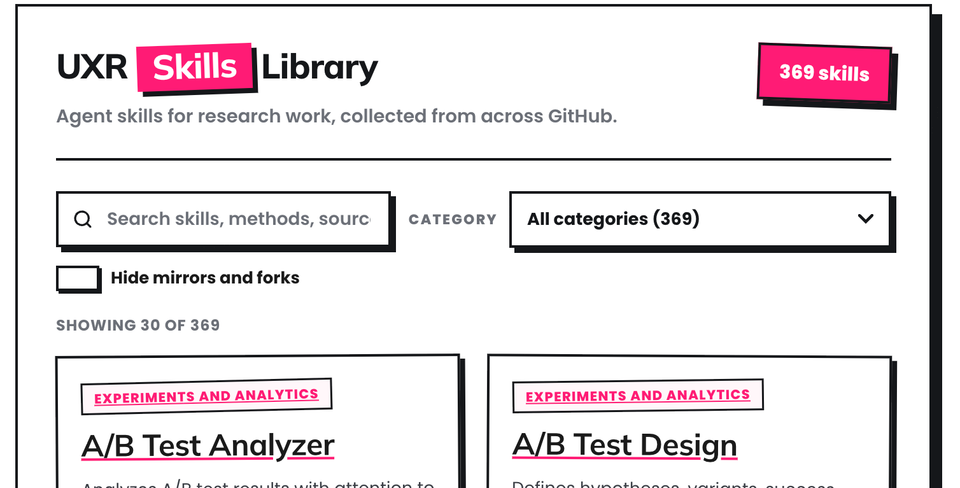
I have spent an unreasonable amount of time on GitHub lately, and I came back with something to show for it: 369 agent skills for UX research, gathered from 66 different collections into one searchable library. It lives on this page. You type what you need, you get the skill, you click through to the source. That is the whole product.
You can access the UXR Agent Skills Libary here.
If you have not run into agent skills yet, the short version is that Anthropic published the format last October. A skill is a folder with a SKILL.md file inside, which is a fancy way of saying it is instructions in markdown that your AI reads when the task matches. You already have these, by the way. Yours are just in a doc called "prompts final v2" that you paste from like a raccoon returning to a good dumpster. A skill is that doc with a filing system and a link you can hand to a colleague.
Once the format existed, people started publishing skills for everything, and research was no exception. There are skills that draft discussion guides, run synthesis, structure usability findings, write screeners, and build journey maps. The problem is that they are scattered across personal repos, plugin bundles, toolkit adaptations, and marketplace catalogs with no index of any kind. Finding them means spelunking, so I did the spelunking and you get the search box. I have now read more SKILL.md files than any regulatory body would recommend.
A few things I learned in there, so you go in with your eyes open.
Of the 369 entries, 86 are mirrors, forks, or old aliases of other entries, because GitHub's favorite genre is the fork of a fork of a repo whose author moved on months ago. I kept them in the library since sometimes the fork is the one still being maintained, but there is a toggle to hide them when you only want originals.
The quality range is enormous. Some of these are careful multi-file systems with checklists and worked examples, clearly written by someone who has sat through a real readout. Some are three prompts in a trench coat. An agent following bad instructions produces confident work in the wrong direction, which is worse than no work at all, so read the SKILL.md before you install anything. It is short. That is the point of the format.
Also, licenses vary. If you are folding one of these into client work or a company workflow, check the repo's license first. This is the least fun sentence in this post and also the one that saves you an awkward email later.
Here is how I would use the library. Search it, open a skill, read it, and then test it on a study you already ran, where you know what good output looks like. If its version of your readout would have embarrassed you in the actual meeting, congratulations, you learned that for free. And once you have read ten of these, do the thing I really want you to do: write your own. Your discussion guide format, your severity scale, and your readout structure are already skills; nobody has written them down yet. That part is on you.
The library gets updated as I find more. If you maintain a skill I missed, or you click a link and find a tombstone, tell me and I will fix it.
🎯 If this gets you to write your own skill, subscribe and then send it to me. Both are free.