Who is getting hired in UX research in 2026, and what they're getting paid

Last week I wrote about Lenny Rachitsky's job market report. It found that about 1,800 user researchers were hired in the US over the past year, down 66% from 2022. I argued that the field is splitting in two, with research work growing while dedicated research jobs shrink.
This post looks at who those 1,800 people are and what they were hired to do. Nobody has published that list. Job postings, pay ranges, and surveys of researchers fill in a lot of it.
My answer is that the market got smaller and also changed what it pays for. It pays for seniority, for data skills, and for research on AI products. Most of the best-paid jobs are at a handful of companies. And almost nobody is hiring the junior researchers who would become the next decade's seniors.
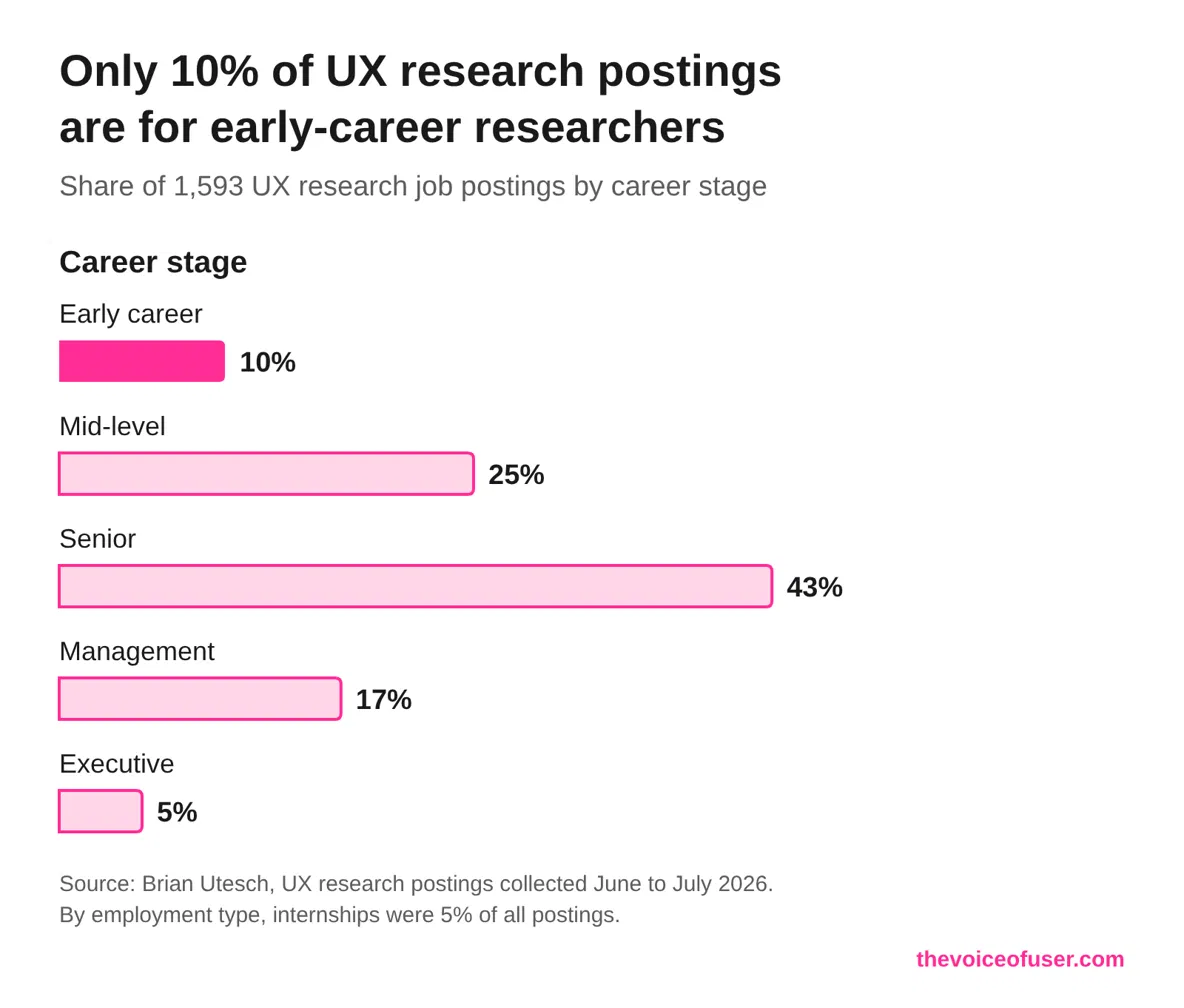
UX research is hiring senior people, and only 10% of postings are for early-career researchers
In June and July 2026, Brian Utesch, a UX researcher, collected and analyzed 1,593 UX research job postings. Only 10% were for early-career researchers. Mid-level roles made up 25%, senior roles 43%, management 17%, and executive roles 5%.
The biggest employers ask for even more experience. Meta's UX Researcher, Quantitative role, posted in May, asked for a bachelor's degree and 10+ years, a master's and 8+ years, or a PhD and 5+ years. Google DeepMind's two open UX research roles for the Gemini app ask for 7+ years and 10+ years.
User Interviews, a research recruiting platform, surveyed 485 researchers for its 2025 State of User Research report. The share of junior individual contributors, meaning researchers who don't manage anyone, fell 8.5 points from 2024. Nielsen Norman Group, a UX research and consulting firm, reports in its State of UX 2026 that senior roles are recovering faster than entry-level ones.
The pay goes to researchers who work with data and study AI products
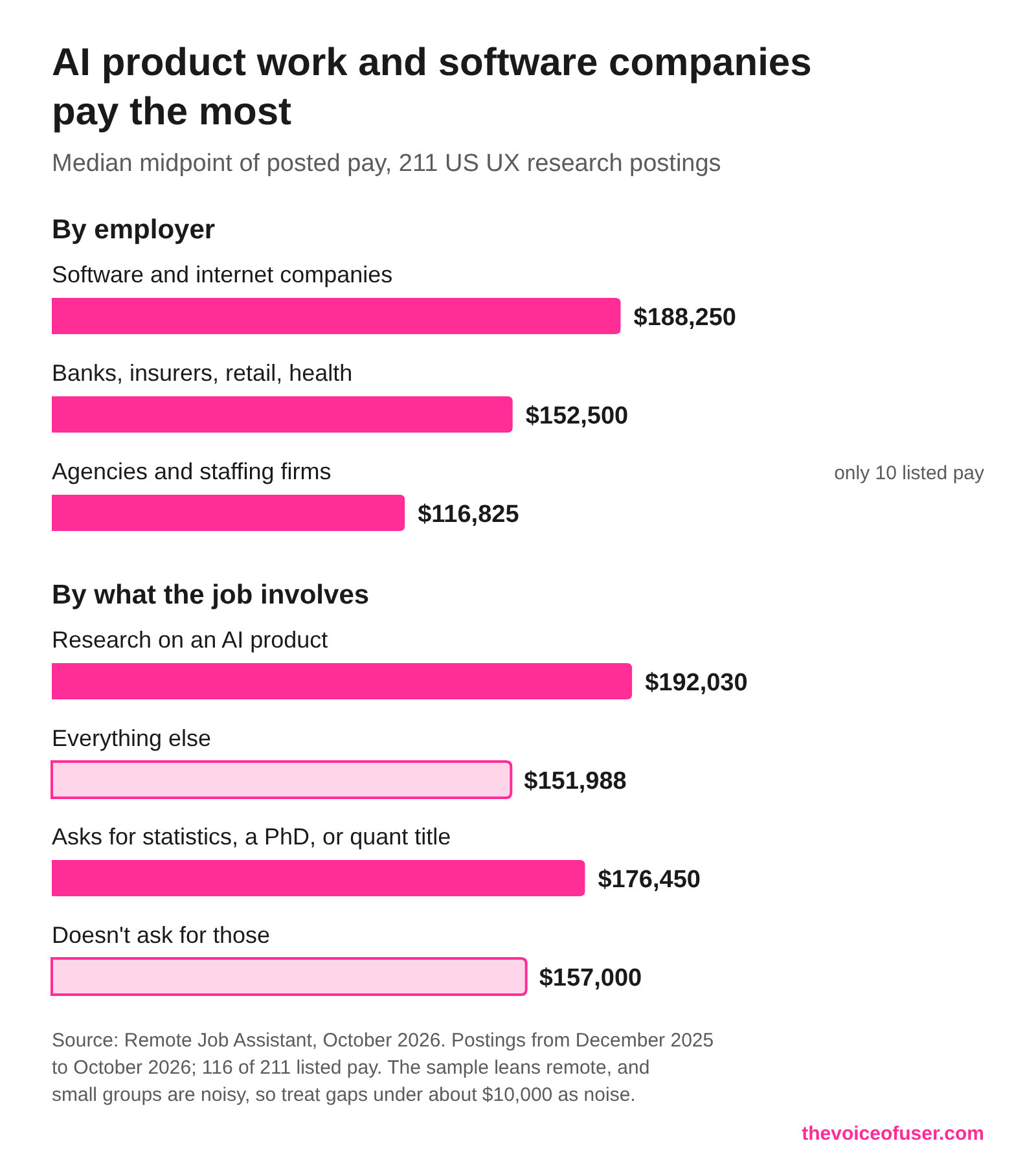
Remote Job Assistant, a remote job board, analyzed 211 US UX research postings from December 2025 to October 2026, using the midpoint of each posted salary range. The 72 postings for research on an AI product had a median midpoint of $192,030. The rest had $151,988.
Postings that asked for statistics or a PhD, or carried a quantitative title, had a median midpoint of $176,450. Postings without them had $157,000. Utesch's larger sample agrees. In 2026, 35% of the postings he collected mentioned AI, and their median posted salary was $178,000, against $155,000 for the rest.
Two postings for the same kind of work show how wide the gap can get. A quantitative UX researcher studies users mainly through surveys, experiments, and behavioral data, and analyzes that data in code.
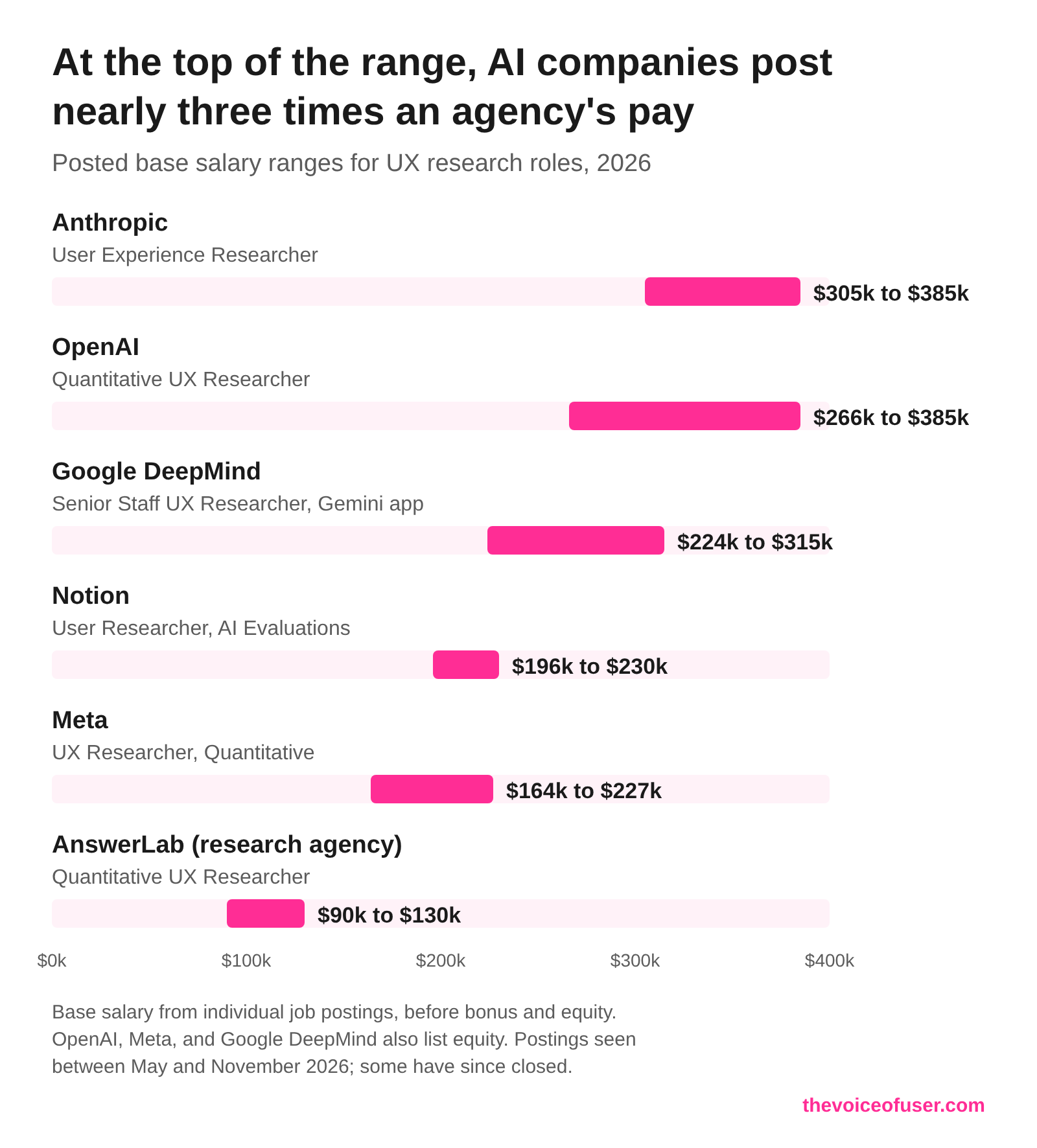
OpenAI's Quantitative UX Researcher role asks for 5+ years and "strong data analysis skills using tools such as SQL and Python." It pays $266,000 to $385,000, plus equity. AnswerLab, a UX research consultancy in New York, listed a Quantitative UX Researcher role this year. It asks for 4+ years with a bachelor's degree, survey design, regression, and R, Python, or SPSS. It pays $90,000 to $130,000.
The skills overlap a lot, and the top of one range is nearly three times the top of the other. What changes is the employer, and what the employer is building.
The AI work is also new work. Google DeepMind's Senior Staff UX Researcher role for the Gemini app is built around what the posting calls "Response Quality," meaning how good the model's answers are for the people asking. It asks for someone who can "influence model training, RLHF pipelines, or UI framework implementation." RLHF stands for reinforcement learning from human feedback, the process that uses human ratings to train a model's behavior.
Notion advertised a User Researcher, AI Evaluations role in June at $196,000 to $230,000. The job was "turning 'soft' user expectations (trust, tone, usefulness, clarity) into concrete rubrics" for Notion's AI features. An eval, short for evaluation, is a structured test of whether an AI's output is good enough, and those rubrics are what the tests score against.
The best-paid jobs are at a few companies, and Google cut researchers in one unit while recruiting them in another
Lenny's report includes a sentence that's easy to miss: "In 2025, Meta and Google alone made about one in eight of all U.S. user research hires, and so far in 2026, Google is the only company to have hired 50 or more."
My rough estimate puts that at about 250 people. Lenny's data shows about 1,800 hires in the latest 12 months and roughly 2,300 in the 12 months before that, so 2025 probably had about 2,000. One in eight of 2,000 is 250.
Part of this is arithmetic. Large research teams keep replacing people who leave, even in a bad year. When almost everyone else stops hiring, those replacement hires become a large share of a small total.
What Google did with its own researchers says more. In October 2025, CNBC reported that Google cut more than 100 design-related roles in its Cloud unit. Internal documents showed the cuts hit its "quantitative user experience research" teams, and some design teams were cut in half. CNBC tied the cuts to Google shifting its spending toward AI infrastructure.
A year later, Google DeepMind is advertising two senior research roles for the Gemini app. The Senior Staff role pays $224,000 to $315,000 in base salary, and the Staff UX Researcher role pays $178,000 to $265,000, both plus bonus and equity. So Google cut quantitative researchers who worked on cloud products, and it is recruiting senior researchers for its AI products. Data skills alone didn't protect those researchers.
One caveat about the hiring count. Live Data Technologies, the source of Lenny's numbers, says it verifies employment from public information on the open web, and it doesn't say how it counts contractors. Google has long relied on contract staff, and a 2019 leaked document showed more temporary and contract workers than full-time employees. Some of those hires may be agency placements, and I don't know how many.
Outside the software companies, the pay drops. In the Remote Job Assistant sample, in-house roles at software and internet companies had a median midpoint of $188,250. Roles at banks, insurers, retailers, and health companies had $152,500, and roles at agencies and staffing firms had $116,825, though only 10 agency postings listed pay.
Contracts made up 16.6% of that sample, almost all of them at agencies, staffing firms, consultancies, or federal contractors, and the 21 postings that paid by the hour had a median of $58.
Location matters too. In Utesch's sample, 31% of postings were in the Bay Area or New York, and nearly three in four wanted people in the office at least part of the week. Fully remote postings paid a median midpoint of $144,000, against $176,000 for hybrid ones.
Experienced researchers are paid by the hour to help train AI on junior work, and almost nobody hires juniors to learn it
There is one more kind of job that most counts leave out. Mercor, a company that supplies experts to train AI models, has posted part-time hourly work for people with 5+ years in user research. The work is grading AI-generated research documents, spreadsheets, and slide decks for accuracy and rigor. Remote Job Assistant excluded nine postings like this from its sample.
Put that next to the 10%. Summaries, slide decks, and first-pass analysis are the work junior researchers used to learn on. Experienced researchers are now paid by the hour to help train AI models to do that work. Meanwhile, nine in ten postings are for people who already have years of experience.
This is the part of the market I worry about most. If almost nobody hires junior researchers now, there will be few mid-level researchers in five years. A few years after that, the companies asking for 10+ years will be competing for fewer and fewer people, because nobody trained them.
If you're early in your career, the research title may not be the way in right now. In the User Interviews survey, 51% of people who used to hold a research title, and still expect research to be central to their work, now hold design titles. If you're mid-career, learn what these postings ask for, which means SQL or Python, experiment design, and building evals for AI features.
If you lead a research team and you have the headcount, hire one junior researcher this year. The seniors you'll want to hire in 2031 have to start somewhere, and right now very few companies are giving them that start.
🎯 If you want those results when I publish them, subscribe. They'll arrive in your inbox first.
📖 If you're trying to move toward the work these postings describe, my book covers the fast-research and AI side of it: AI-Powered UX Research, the operating manual for running research at the speed your team needs.